- Vehicle Export
 $102 310$99 500$65 000$58 900

- Vehicle Export
- $41 700$38 990$32 400
FAQ
Buyer and Hospital Workflow FAQ
Automatic Patient Transfer Stretcher FAQ
Direct answers for hospitals, medical-equipment distributors, importers, project contractors, and procurement teams evaluating powered lateral patient transfer and in-hospital transport.
Quick answer: An automatic patient lateral transfer stretcher combines a powered
lateral-transfer surface with a mobile hospital stretcher. It supports transfer between compatible
adjacent surfaces and then serves as the transport unit for the journey between departments.
Developed by YuanPort
Assembled and tested by YuanPort
Practical hospital operation experience
Decision summary
What Buyers Should Understand Before Comparing Products
The most important distinction is whether a product only transports a patient, only assists lateral transfer, or integrates both functions in one mobile unit.
YuanPort's intended product position
A mobile stretcher that supports powered lateral transfer at the sending surface, in-hospital transport, and powered transfer at the receiving surface.
- Transfer and transport are evaluated as one connected workflow.
- Compatibility must be confirmed against the buyer's beds and tables.
- Clinical assessment and trained operation remain necessary.
- Specifications, certification, and support must be confirmed by model.
| Equipment type | Main purpose | Transport function | What the buyer must check |
|---|---|---|---|
| Normal transport stretcher | Moves a patient after loading | Yes | Usually requires a separate loading or lateral-transfer method |
| Air-assisted or sliding transfer aid | Assists lateral movement between surfaces | Usually not a complete mobile stretcher | Mattress, air supply, staffing, storage, and compatible surfaces |
| Automatic patient transfer stretcher | Integrates powered lateral transfer and transport | Yes | Mechanism, interface range, operating limits, training, and service |
Product Basics
Product Basics and Terminology
Clear definitions help hospitals and distributors distinguish an automatic transfer stretcher from ordinary transport stretchers and separate transfer aids.
What is an automatic patient lateral transfer stretcher?
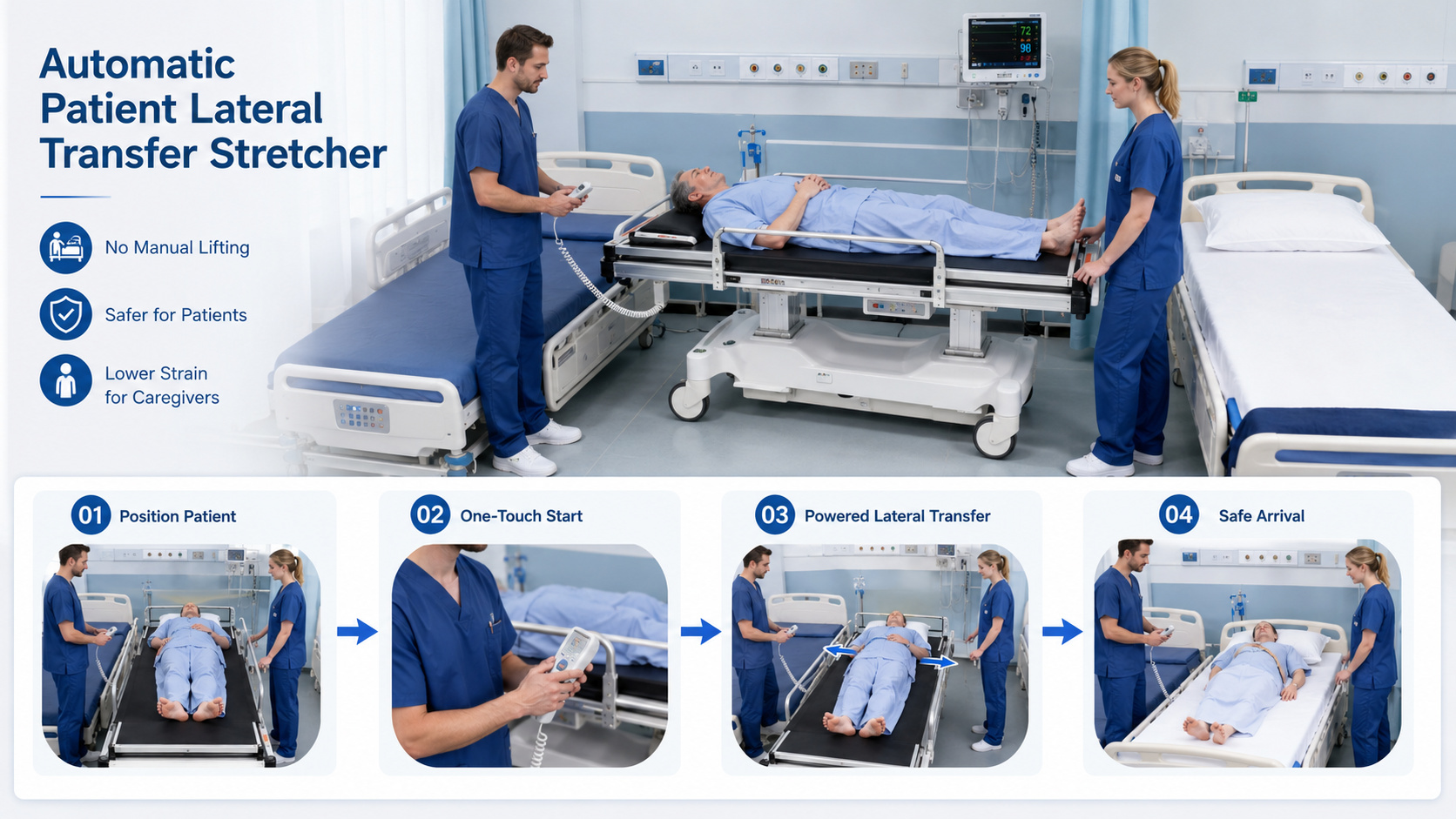
An automatic patient lateral transfer stretcher is a mobile hospital stretcher with a powered transfer surface that supports lateral movement of a patient between adjacent support surfaces, such as a hospital bed, the stretcher, and an operating table. It combines patient transfer and in-hospital transport in one unit. The exact mechanism, operating range, and permitted uses depend on the selected model and its instructions for use.
How is it different from a normal hospital transport stretcher?
A normal transport stretcher is primarily designed to carry a patient after the patient has already been placed on it. An automatic patient transfer stretcher also includes a powered lateral-transfer function, so it can support the loading and unloading stages at the beginning and end of the transport journey. Buyers should compare the transfer mechanism, compatible surfaces, operating limits, cleaning requirements, and service plan rather than comparing only the trolley frame.
Is it the same as an electric patient transfer bed or patient transfer trolley?
These terms are often used for overlapping product categories, but they are not always identical. “Electric patient transfer bed” emphasizes the powered function, while “patient transfer trolley” or “stretcher trolley” emphasizes mobility. YuanPort uses “automatic patient lateral transfer stretcher” because it identifies both the product form and its core lateral-transfer function.
How does the powered lateral transfer function work?
The stretcher is positioned beside a compatible patient support surface and the two surfaces are prepared and aligned. Trained staff then operate the powered transfer surface to support controlled lateral movement of the patient onto or off the stretcher. Staff remain responsible for patient assessment, line management, alignment, observation, positioning, and operation according to the supplied instructions.
Can the stretcher transfer a patient in both directions?
Bidirectional operation must be confirmed for the exact configuration. Where supported, the powered transfer function can be used for the journey from a hospital bed to the stretcher and again from the stretcher to a compatible operating table or hospital bed, including the reverse workflow after a procedure. The quotation and technical sheet should state the permitted transfer directions clearly.
Does the equipment completely eliminate manual patient handling?
No medical transfer device should be presented as eliminating every form of manual patient handling in every clinical situation. The powered transfer surface is designed to help reduce manual lifting, dragging, and pulling during suitable lateral transfers. Trained staff are still needed for assessment, preparation, line and limb management, monitoring, alignment, positioning, and clinical handover.
Workflow & Compatibility
Hospital Workflow, Patient Suitability and Surface Compatibility
A purchasing decision should be based on the hospital's real surfaces, patient population, staffing model, and transfer protocol.
What is the typical bed-to-operating-room workflow?
A typical workflow has four connected stages: position and align the stretcher beside the hospital bed; use the powered surface to transfer the patient onto the stretcher; transport the patient to the operating room or other department; then realign and transfer the patient to the receiving surface. The reverse process may be used for the return journey when permitted by the model and clinical protocol.
What support surfaces can the stretcher transfer between?
Potential transfer points include compatible hospital beds, ward beds, transport stretchers, operating tables, examination tables, and other adjacent patient support surfaces. Compatibility should never be assumed from the product name alone. YuanPort should review the surface height, dimensions, access, clearances, mattress condition, and intended workflow before confirming suitability.
Will it work with every hospital bed and operating table?
No. Universal compatibility should not be claimed. Beds and tables differ in height, width, side structures, mattress design, access space, and permitted loading conditions. Before ordering, provide model information, photographs, drawings, or measurements of the intended sending and receiving surfaces so the interface can be evaluated.
Which hospital departments may use this type of stretcher?
Potential applications include operating rooms, general wards, ICUs, emergency departments, recovery areas, rehabilitation departments, and other units that perform repeated lateral transfers. Final suitability depends on patient assessment, department workflow, room layout, infection-control requirements, and the selected configuration.
Which patients may be suitable for powered lateral transfer?
The equipment may be considered for non-ambulatory or mobility-limited patients who require transfer between adjacent support surfaces. Suitability must be determined by qualified clinical staff based on the patient's condition, body dimensions, weight, cooperation, skin condition, injuries, attachments, and any contraindications stated in the instructions for use.
Who should operate the stretcher and how many staff are required?
Only trained personnel should operate the equipment. Staffing cannot be stated as one universal number because it depends on the patient, hospital policy, line management, destination surface, and local safe-patient-handling protocol. The user manual and training program should define the minimum operational roles and the circumstances requiring additional staff.
How should IV lines, drains, catheters, and monitoring cables be managed?
Clinical attachments must be assessed and managed before, during, and after movement. Staff should confirm that tubes, lines, cables, limbs, clothing, and bedding are protected from tension, entrapment, disconnection, or interference with the transfer path. The transfer should be paused if alignment changes, unexpected resistance occurs, or any attachment becomes unsafe.
Specifications
Configuration, Dimensions and Technical Specifications
Exact specifications should come from a model-specific technical sheet, not from general marketing statements.
What specifications should a buyer confirm before ordering?
At minimum, confirm the rated patient load, overall dimensions, transfer-surface dimensions, operating height range, interface requirements, transfer directions, power system, charging requirements, control functions, braking and mobility features, cleaning materials, accessories, packing dimensions, and service requirements. Also confirm which specifications are standard and which depend on an optional configuration.
What is the stretcher's load capacity?
Load capacity is model-specific and should be stated on the formal specification sheet, product label, quotation, and instructions for use. Do not rely on an informal website number if the ordered configuration may differ. The hospital must also confirm that all connected beds, tables, accessories, elevators, and transport routes are suitable for the intended patient load.
How is bed-height and operating-table compatibility assessed?
Compatibility is assessed by comparing the stretcher's operating height range and transfer interface with the sending and receiving surfaces. Buyers should provide the minimum and maximum surface heights, mattress height, side access, under-bed clearance, and any fixed obstacles. A photo or short video with measurements is often more useful than a model name alone.
What dimensions should be checked for corridors, doors, and elevators?
Check the stretcher's overall length, width, turning space, wheelbase, handle position, and transport height against the hospital's narrowest doorway, corridor turn, elevator entrance, elevator interior, and storage area. Buyers should also consider ramps, floor transitions, thresholds, and the space required for staff to operate beside the equipment.
What power, battery, charging, and emergency information should be requested?
Request model-specific information covering input voltage, plug type, charger, battery type, expected operating cycle, charging time, battery replacement procedure, low-power indication, and the procedure for power interruption or malfunction. Any emergency stop, manual recovery, backup, or alarm function should be confirmed in writing for the exact supplied configuration.
Which controls, brakes, side rails, and safety features are included?
The supplied controls and safety features depend on the model. Ask for labeled photographs or drawings showing the transfer controls, brakes, casters, side rails, handles, indicators, emergency functions, and any interlocks or restraints. The sales quotation should distinguish standard features from optional accessories and should not use generic product photographs as the only confirmation.
Can YuanPort customize the stretcher?
Customization may be possible for selected dimensions, electrical requirements, labeling, accessories, packaging, or project-specific needs, subject to engineering review and regulatory impact. Buyers should not assume that every modification is available or that a customized version retains the same certification status. YuanPort should confirm feasibility, validation needs, lead time, minimum quantity, and documentation before an order is placed.
Safety & Service
Training, Cleaning, Maintenance and After-Sales Support
Equipment performance depends on correct implementation, operator competence, maintenance, and access to service information.
What operator training is required?
Training should cover patient and surface assessment, equipment inspection, positioning and alignment, use of controls, management of lines and limbs, stopping criteria, transport checks, destination transfer, cleaning, charging, and routine inspection. The purchase agreement should state whether training is remote, on-site, distributor-led, or supported by videos and manuals.
How should the stretcher be cleaned and disinfected?
Cleaning and disinfection must follow the model-specific instructions and the hospital's infection-control policy. Request a list of approved cleaning agents, prohibited chemicals, water-ingress limitations, cleaning frequency, removable components, contact times, and post-cleaning inspection steps. Do not assume that all surfaces can be sprayed, soaked, or cleaned with the same disinfectant.
What preventive maintenance is required?
Preventive maintenance should include the checks and intervals defined by the manufacturer for the transfer mechanism, controls, electrical system, battery, charger, frame, casters, brakes, rails, fasteners, and wear components. Buyers should request a maintenance schedule, inspection checklist, service manual availability, required tools, and the qualifications expected of service personnel.
Are spare parts and warranty support available?
Spare-parts availability and warranty coverage should be defined in the quotation or distribution agreement. Ask for the warranty period, exclusions, response process, parts list, expected availability period, shipping method, responsibility for labor, and the process for diagnosing faults. Critical wear parts and recommended initial spare parts should be identified before shipment.
What overseas after-sales support can YuanPort provide?
The support package should be agreed for the destination market and may include remote technical communication, operating guidance, training materials, troubleshooting, spare-parts supply, maintenance documentation, and coordination with a local distributor or service partner. Buyers should request named communication channels, expected response times, escalation procedures, and any services that require an additional fee.
Certification & Purchase
Certification, Import, Shipping, Pricing and Procurement
Medical-device requirements differ by model and destination. Buyers should verify documents before paying a deposit or committing to a tender.
Is the automatic patient transfer stretcher CE or ISO certified?
Certification status is model-specific and market-specific. Do not rely on a general statement such as “CE/ISO supported.” Before ordering, request the exact certificate, issuing body, scope, model reference, validity dates, applicable standards, declaration of conformity, and quality-management documents that are relevant to the product and destination market.
Can the stretcher be registered or imported as a medical device in my country?
Registration and import requirements vary by country and product classification. The local importer or authorized representative is usually responsible for confirming the applicable pathway, while YuanPort can discuss the manufacturer-side documents available for the selected model. Regulatory acceptance should be verified with the competent authority or a qualified local regulatory professional before shipment.
What export and shipping documents can YuanPort provide?
Available documents depend on the model, destination, Incoterm, and transaction structure. A shipment may require a commercial invoice, packing list, transport document, certificate of origin, product documents, and other customs or medical-device records. The required document list should be agreed in writing before production and checked by the buyer's importer or customs representative.
How are price, minimum order quantity, and lead time determined?
Price, MOQ, and lead time depend on the configuration, accessories, customization, documentation, quantity, packaging, destination, shipping method, and production schedule. A useful quotation should separate product price, optional items, spare parts, training, documentation, packing, freight, insurance, taxes, and any local service responsibilities.
What information should I send to receive an accurate quotation?
Send your country, buyer type, intended hospital departments, sending and receiving surface details, patient profile, required quantity, electrical requirements, requested documents, preferred Incoterm, destination port or city, delivery target, and any tender or customization requirements. Photographs, measurements, model numbers, and a short workflow video can help YuanPort evaluate compatibility more accurately.
Procurement checklist
Information to Exchange Before a Technical Quotation
A serious quotation should be based on the intended clinical workflow and exact receiving surfaces, not only on a product photograph.
Information the buyer should send
- Destination country
- Buyer and importer type
- Hospital departments
- Bed and table models
- Surface heights and dimensions
- Typical patient profile
- Required quantity
- Electrical requirements
- Delivery target
- Tender or customization needs
Documents the buyer should request
- Model-specific specification sheet
- Configuration and accessory list
- Operating demonstration video
- Instructions for use
- Cleaning guidance
- Maintenance information
- Certification documents
- Packing and shipping data
- Warranty and support terms
- Spare-parts plan
Independent context
Authoritative Guidance Relevant to Patient Handling and Import Review
These independent sources provide general context for safe patient handling, training, equipment selection, and medical-device import review. They do not certify or validate a specific YuanPort model.
OSHA: Safe Patient HandlingGeneral guidance on assistive equipment, implementation, and staff safety.
NIOSH: Safe Patient Handling and MobilityContext on equipment access, staff training, policies, and injury prevention.
WHO: Unsafe Patient HandlingGeneral occupational-health context for lifting, transferring, and moving patients.
FDA: Importing Medical DevicesUnited States import context; other countries have their own requirements.
YuanPort recommends that overseas buyers verify regulatory requirements with the competent authority, importer, authorized representative, or qualified regulatory professional in the destination market.
Send YuanPort Your Transfer Workflow and Surface Information
Use the existing inquiry form directly below this page. Include your target country, bed and table information, hospital departments, required quantity, requested documents, and delivery timeline.